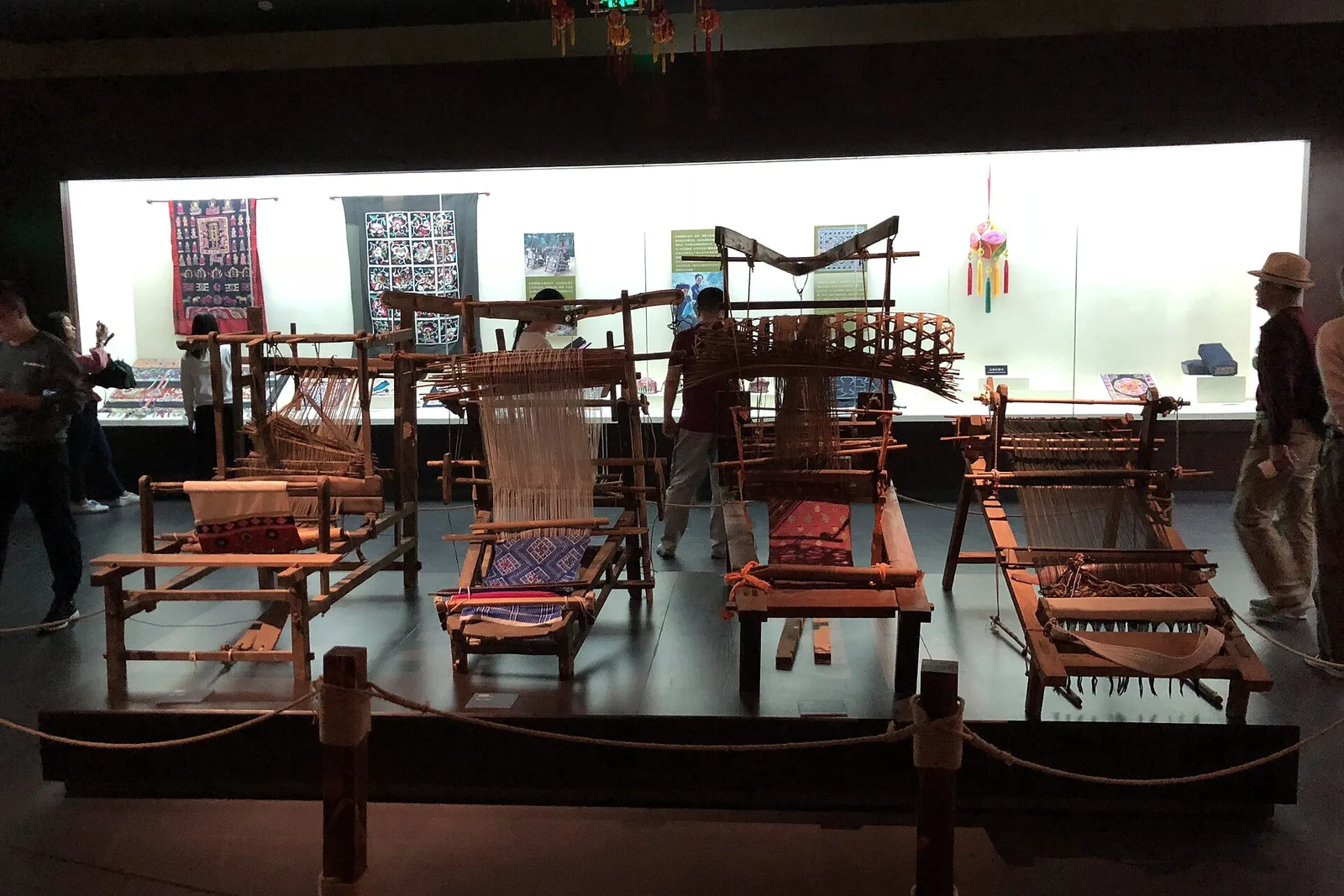
Longji's villages are also workshops. Zhuang women weave brocade on wooden looms, Yao silversmiths make jewellery for festival dress, and baskets, embroidered cloth, and bamboo rice tubes turn up in every village shop. Some of it is handmade; some is factory stock with a local label. The difference matters, both for what you are buying and for who benefits.
In short
Buy from the maker where possible, ask who made the piece, and expect ¥50–200 for small brocade work and ¥150–500 for silver. A price that seems too cheap usually is.
Before you book
Prices and schedules change
Reserve the fixed-time items first, then build the rest around the weather. If you are deciding between two versions of the trip, send both.
Zhuang brocade
Zhuang brocade is woven in geometric patterns, often with bright colours on a dark ground. It is one of China's best-known regional brocades, used for baby carriers, blankets, and bags. Handwoven pieces take days; machine copies take minutes.
Look at the back of the cloth. Handwoven brocade shows floats where the pattern colour is carried across, and slight irregularities in the selvedge. Machine cloth is uniform and often thinner. Small handwoven pieces start around ¥50–100; larger blankets and bags run ¥150–400.
Yao silver and embroidery
Yao silver jewellery is festival dress as much as ornament: headdresses, neck rings, earrings, and chains. In Dazhai and the surrounding villages, silversmiths still make pieces by hand, while markets sell cast and machine-finished versions by weight.
Ask whether the piece is handmade and who made it. Silver is usually priced by weight plus workmanship; a suspiciously low price means a different alloy or a factory piece. Embroidery and long-hair Yao headscarves are separate crafts, often sold by the maker at village stalls.
How to tell the difference
Handmade work has small asymmetries: a pattern that shifts by a thread, a hammer mark, a slightly uneven edge. Factory work repeats perfectly and often uses printed fabric instead of woven. Ask to see the back, the selvedge, or the clasp.
Do not bargain hard on a piece someone made by hand. A fair price is part of supporting the craft. If a seller cannot tell you who made an item, treat it as a souvenir rather than a craft purchase.
Where to buy
The best place is a village shop in Ping'an or Dazhai, where you can meet the maker or the maker's family. Guilin city museums and craft shops have better labels and higher prices. Yangshuo has the widest selection and the most factory stock.
Carry cash for village purchases, as QR payments can fail for foreign cards. The Longsheng area guide covers transport, and the local experiences page lists workshop visits if you want to try the craft yourself.
Verdict
Buy less, ask who made it, and pay the maker directly.
Next in the manual
04 linksField desk / direct line
Not sure this fits your trip?
Send the dates, the group, and what you are deciding between. The field desk will tell you what to cut and what to keep.
Independent advice. No bookings, no commissions, no visa service.