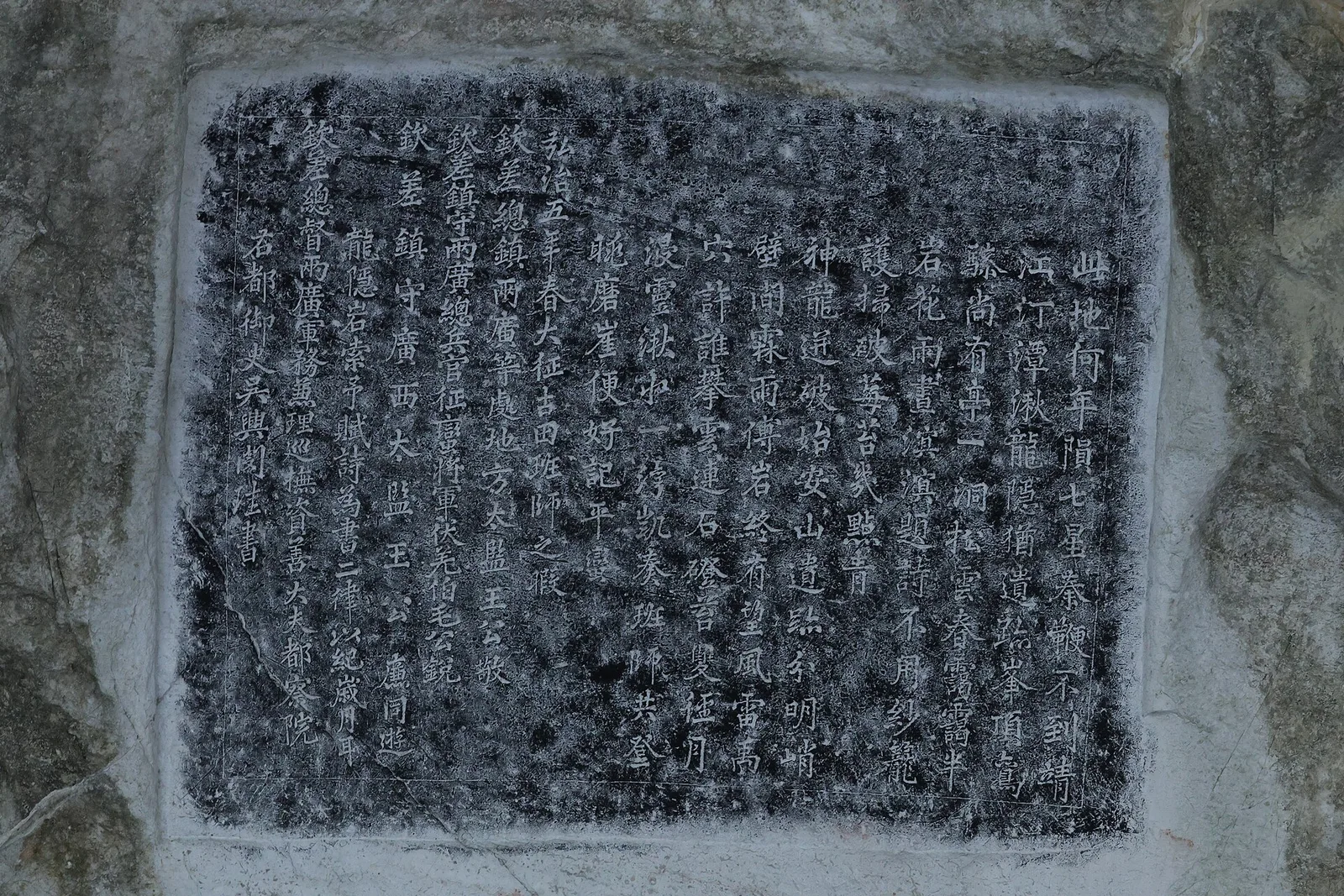
Guilin's hills are not only scenery. They are an archive. From the Tang dynasty onward, officials, monks, scholars, and travellers carved poems, memorials, and sutras into cave walls and cliff faces, leaving one of China's densest collections of cliff inscriptions. The writing is easy to walk past. Once you start looking, the karst becomes a library with a landscape attached.
In short
Start at Longyin Cave and the Guihai Steles Forest, then look for inscriptions at Duxiu Peak and Fubo Hill. Give it two hours, bring a translation app, and do not touch the stone.
Before you book
Prices and schedules change
Reserve the fixed-time items first, then build the rest around the weather. If you are deciding between two versions of the trip, send both.
Why the hills are full of writing
Karst caves gave travellers shelter and monks a place to live, and both left marks. Passing officials recorded inspections and military campaigns; poets wrote about the view; pilgrims commissioned Buddhist texts. Because the stone survived, the inscriptions form a continuous record of who came to Guilin and what they thought of it.
The result is not a single monument but a scattered archive. Some carvings are monumental and easy to find; others are small, weathered, and half-hidden behind vegetation. The pleasure is in spotting them rather than ticking off a list.
Where to read them
Longyin Cave, on the western edge of the city, holds the densest collection and is usually visited as the Guihai Steles Forest. The cave and its attached halls cover Song to Qing material, including large characters and memorial texts. It is the best single stop for a first visit.
Duxiu Peak inside the Jingjiang Prince City has inscriptions close to the summit path and at the base. Fubo Hill and the Xishan grottoes add Buddhist carvings and more scattered pieces. The city centre area guide explains how to link the sites without crossing the city twice.
How to read a rubbing
Traditional rubbings are made by laying paper over the stone, dampening it, and tapping ink across the surface. The carved characters stay white while the surrounding stone goes black. Museums and workshops sell rubbings, and some studios let visitors try the technique.
When you look at an inscription, find the date first, then the author's name and title. The calligraphy style tells you the period: regular script for official texts, running or cursive script for poems. A translation app can handle short passages, but the pleasure is often visual rather than literal.
Visiting with respect
Do not touch, rub, or trace the carvings; skin oils and abrasion damage the surface. Do not add your own marks. Flash photography is usually fine outdoors but can be prohibited in caves, and tripods may block narrow paths.
Many inscriptions are unlabeled in English. A local guide or a museum label adds context, but it is also fine to look without understanding every character. The language briefing covers translation tools. If you want a guided reading, the trip review page can point you to the right kind of guide.
Verdict
Look up. The karst is a library, and most visitors read only the view.
Next in the manual
04 linksField desk / direct line
Not sure this fits your trip?
Send the dates, the group, and what you are deciding between. The field desk will tell you what to cut and what to keep.
Independent advice. No bookings, no commissions, no visa service.